
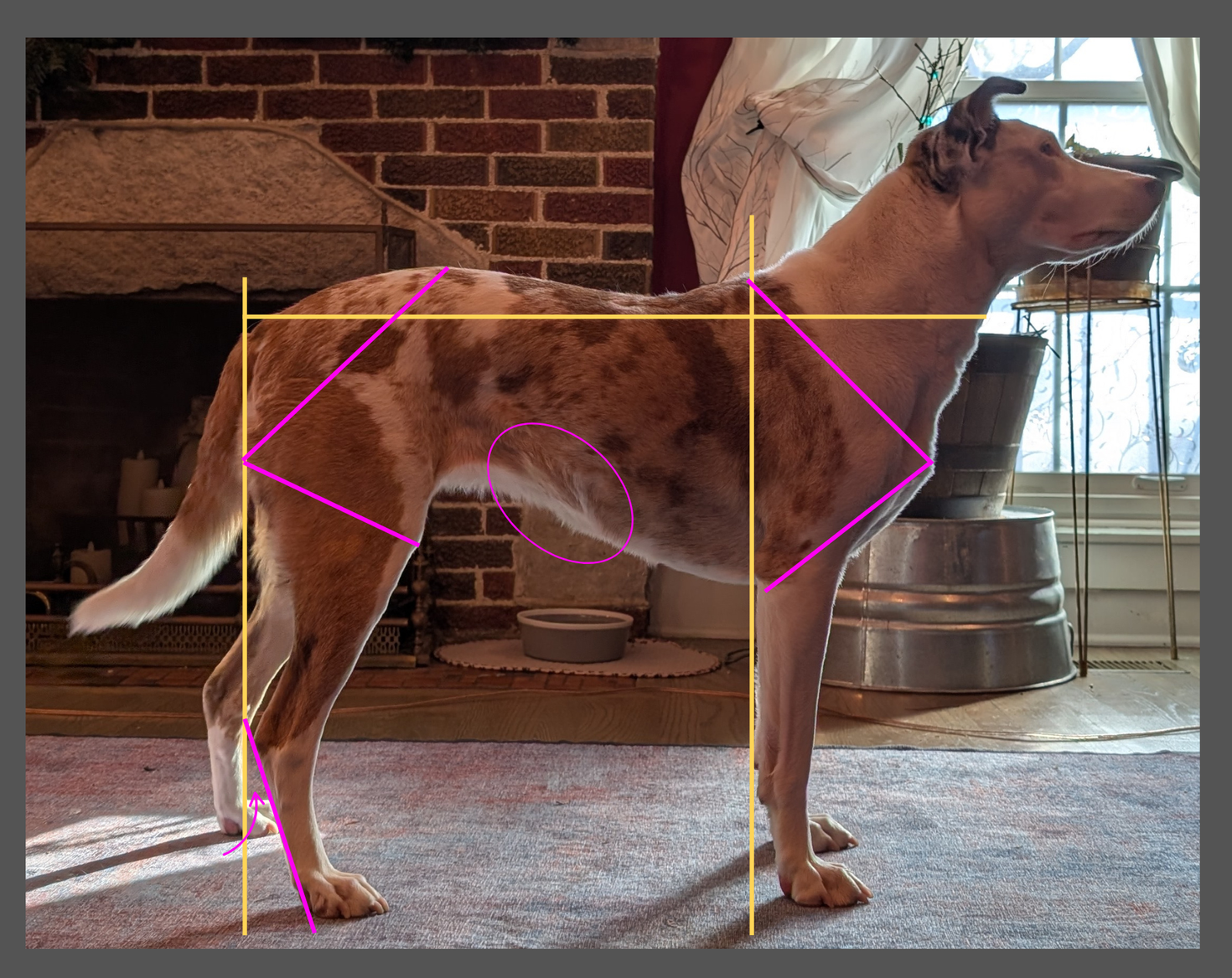
Dynamic Dog Assessment
In my behaviour cases, pain or physical discomfort has been a contributing factor in 84% of cases in 2024 and 88% in 2025.
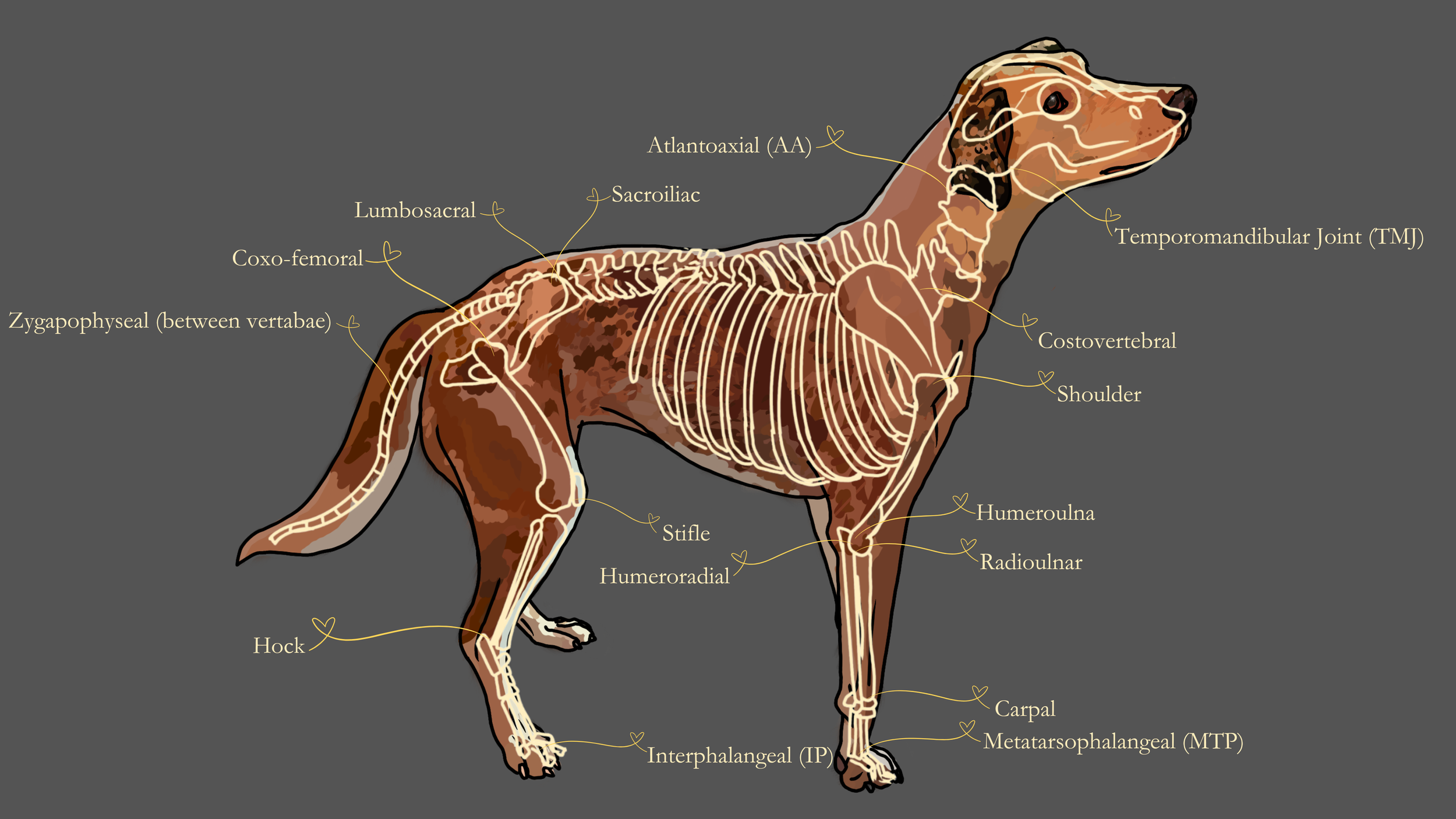
Not obvious pain. Not limping or yelping. The quiet kind — the kind that shows up as a dog who's harder to reach than they used to be, or more reactive than the training accounts for, or simply not improving the way they should be.
If you've been doing everything right and something still isn't working, this is often why.
A Whole-Dog Lens When Training Isn't Enough
I work with dogs and guardians who are doing careful, ethical training — and still feel stuck.
When progress stalls or something keeps getting harder without a clear reason, my first question isn't "How do we fix this?" It's "What information are we missing?"
A Dynamic Dog Assessment is how we figure out the whole picture.
What a Dynamic Dog Assessment Is
A Dynamic Dog Assessment is a structured, whole-dog evaluation that looks beyond surfacebehaviour to understand how a dog’s body, movement, physical comfort, and lived experience may be shaping what you’re seeing.
Rather than focusing on isolated behaviours, this process examines patterns across:
Movement and posture
Daily routines and environmental demands
Emotional regulation and stress responses
Contextual triggers and recovery
The goal is not to label or pathologize your dog. The goal is to identify missing information that may be limiting progress.
A Dynamic Dog Assessment helps answer questions like:
Why does progress fall apart under pressure?
Why does my dog cope well in some contexts but not others?
Why does this behaviour persist despite thoughtful training?
This work focuses on patterns, not symptoms, and on understanding before intervention.
Why Behaviour Isn’t the Whole Story
Behaviour doesn’t happen in a vacuum.
How a dog moves, how comfortable they are in their body, and how well they can recover from stress all influence how they respond to the world. When a dog’s body isn’t working smoothly, behaviour is often where the strain shows up first.
This doesn’t mean behaviour work is wrong or unnecessary. It means behaviour is often the signal, not the source.
Dogs are very good at coping. They adapt, compensate, and push through discomfort, often quietly. Over time, that effort can show up as:
Lower tolerance for frustration or proximity
Bigger reactions or slower recovery
Avoidance of activities that used to be easy
Inconsistent engagement or performance
Reactions that feel out of proportion to the situation
Seen on their own, these changes are easy to mistake for training gaps, motivation issues, or “bad behaviour.”
A Dynamic Dog Assessment creates space to ask a different question:
What might this dog be working around in order to cope at all?
Dynamic Dog Assessment: Pricing
Dynamic Dog Assessment
Investment: $250
This is a comprehensive, investigative service designed to support clarity when training alone has stalled or behaviour no longer makes sense on its own.
Your assessment includes:
A detailed intake and history review (~90 minutes)
Guided video and photo submission instructions
In-depth analysis of movement, posture, and behavioural patterns
A written summary of findings
A structured report designed to support veterinary and specialist collaboration
Liaison with your dog’s existing support team, including veterinarians, professional dog trainers and canine behaviour consultants, and other professionals involved in your dog’s care (with your consent)
A follow-up discussion to review findings and next steps
This process is thoughtful, time-intensive, and tailored to your individual dog. It is not a quick consultation or a one-size-fits-all evaluation.
Most assessments result in a clear set of next steps — whether that's adjusted training, veterinary follow-up, or both.
You won't leave without a direction.
A Note on Scope
A Dynamic Dog Assessment does not provide a medical diagnosis and does not replace veterinary care. Instead, it helps identify patterns and possibilities that may warrant further investigation or adjustment — so decisions can be made with greater confidence and care.
Because of the depth of this work, Dynamic Dog Assessments are offered in limited numbers.
Is This the Right Next Step?
If you've been doing careful, thoughtful work with your dog and something still isn't shifting, this is worth exploring.
If you're not sure, reach out. I'm happy to talk it through before you commit to anything.
Frequently Asked Questions
Still have questions?
Take a look at the FAQs here, or reach out anytime. If this feels like the right next step, you’re welcome to apply.
-
No. A Dynamic Dog Assessment is not a training session and does not replace training. It is an investigative process designed to understand factors that may be influencing behaviour, especially when training progress has stalled or become inconsistent.
Many clients choose to pursue or adjust training after an assessment, once there is greater clarity.
-
No. I do not diagnose medical conditions or provide veterinary treatment.
A Dynamic Dog Assessment identifies patterns, observations, and areas of concern that may warrant further investigation. Findings are documented in a structured report that can be shared with your veterinarian to support next steps.
-
No — and it isn’t meant to.
This service is designed to support veterinary care by helping clarify what to look at and how behaviour, movement, and daily life may be interacting. Many guardians find it helps make veterinary appointments more focused and productive.
-
Yes. Diagnosing pain and medical conditions is the role of your veterinarian.
A Dynamic Dog Assessment does not diagnose pain. Instead, it helps identify patterns and observations that may suggest where pain, discomfort, or physical strain could be influencing behaviour — especially when signs are subtle, inconsistent, or context-specific.
This information can help your vet:
Know what to look at more closely
Decide which diagnostics may be most useful
Understand how behaviour, movement, and daily life may be interacting
Many guardians find that a Dynamic Dog Assessment makes veterinary conversations more focused and productive, particularly when previous exams or tests haven’t fully explained what they’re seeing.
-
Yes, with your consent.
The assessment includes liaison with your dog’s existing support team — such as veterinarians, trainers, or other professionals — to help ensure everyone is working from the same information and understanding.
-
A Dynamic Dog Assessment is often helpful if:
Training has stalled or progress feels fragile
Behaviour seems disproportionate or inconsistent
You’re concerned about pushing your dog without understanding why things are hard
You want clarity before deciding what to do next
If you’re unsure, you’re welcome to reach out and talk it through before booking.
-
Yes. With your consent, I can communicate with your dog’s existing support team — such as veterinarians, trainers, or other professionals — to share assessment findings and help support coordinated care. Reports and shared insights can make veterinary and behaviour planning more efficient and informed.
This collaboration helps ensure everyone is working from the same information and supports clearer, more coordinated decision-making for your dog.
-
No — many dogs with underlying discomfort don’t show obvious signs like limping or yelping. In up to 80% of behaviour cases, pain or discomfort may be contributing to the issue in subtle ways that aren’t detected in short clinical exams.
In my behaviour cases, pain has been a contributing factor in 84% (2024) and 88% (2025) of the cases I’ve seen.